

Bamboo Removal Devon, Cornwall & the South West
Expert Bamboo Removal, Treatment & Surveys Across Devon, Cornwall, Somerset, Dorset & Bristol.
Southwest Knotweed Group now offer Bamboo Insurance Backed Guarantees! Click here for more information.
About Bamboo and Its Invasive Nature
Bamboo is a large group of over 1,000 species of plants in the grass family. In the United Kingdom, more than thirty species are often grown as ornamental garden plants.
Bamboo is grown as an effective screening plant that provides garden decoration but is difficult to manage because of its fast growth and often becomes an invasive nuisance to property owners.
Few property owners understand the effect that bamboo can have on their property and how best to manage it and control it.
Its invasive nature can mean that it does not leave any room for other plants to flourish in that area or even leaves the area with not enough space to be used for the intended purpose.
Understanding the different types of bamboo plants and their characteristics helps to determine what the best control measures for managing bamboo may be.
Our experienced bamboo surveyors have provided professional invasive plant management services across the South West since 2011.
This guide will outline information on bamboo growth and removal, specifically for properties in Cornwall, Devon, Bristol, Dorset, and Somerset.
There are various types of bamboo plants, and some are far more invasive than others. However, within the United Kingdom, there are two types of bamboo that are most commonly found: running bamboo and clumping bamboo.
Case study:
Bamboo Removal for Health & Safety at Local School
Southwest Knotweed was instructed to remove two stands of Arrow Bamboo from a school in Cornwall. The bamboo has sharp culms and was a potential cause of injury to children in the play area. The details below describe the process of removal.
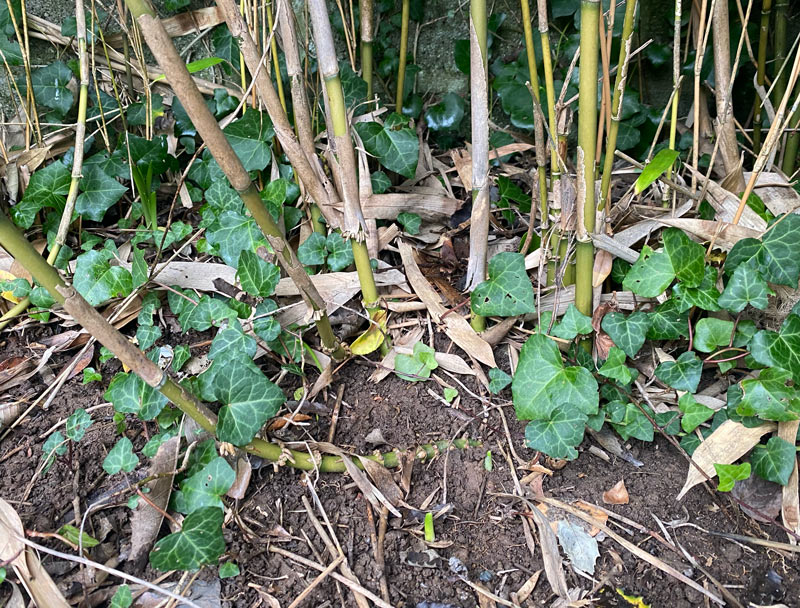
Running Bamboo
This invasive species of bamboo grows with roots that spread laterally up to 20 metres from the plant itself. Bamboo grows underground but only becomes visible when its lateral bamboo rhizomes begin to shoot up new bamboo Culms in new areas. This invasive bamboo species can damage your property by exploiting weaknesses in your pipes, drains, bricks, walls, patios, and even your building’s foundation.
At the moment, there is no individual piece of legislation in the UK that governs the growth of bamboo.
However, homeowners and landowners are protected by the common law on public nuisance if bamboo spreads to a neighbouring property.
Should bamboo spread to affect neighbouring properties by allowing its spread to continue, legal action can be brought against a homeowner whose property that bamboo was once confined to.
In order not to damage your property and become the subject of legal action, it is strongly advised that you keep this invasive species of bamboo in check before it damages your property or spreads to other properties.
Early identification and professional bamboo removal can help prevent structural damage and reduce the risk of neighbouring property encroachment.
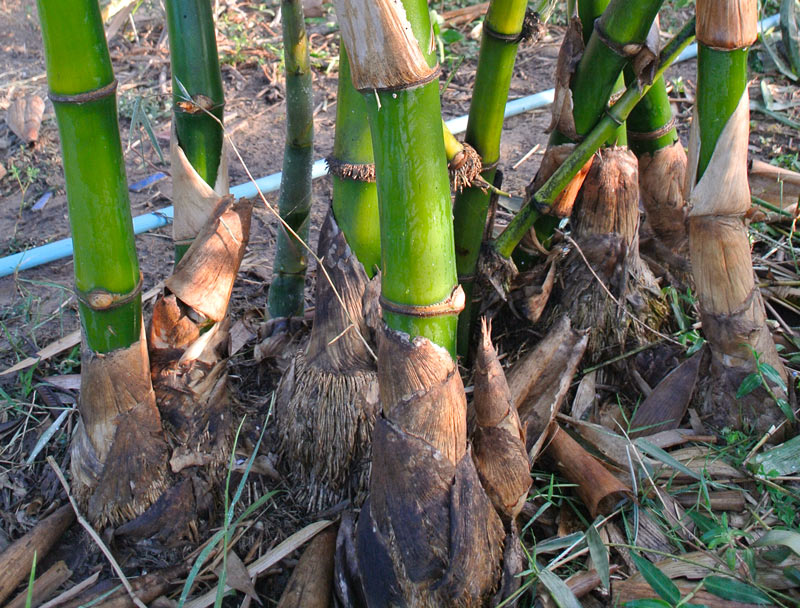
Clumping Bamboo
Clumping Bamboo is vertically orientated in its rhizome growth, as opposed to the running type, whose rhizomes grow horizontally. Clumping bamboo is less conservative than running bamboo; however, it can still outgrow its space, outcompete other plants, and take over where something else is desired. If it is left alone, it can still do damage, so it is best to think of means to control it.
How Fast Does Bamboo Grow?
In the United Kingdom, factors such as local area, soil, water, air quality and sub-ground conditions will affect how quickly bamboo grows.
Bamboo growth is erratic and can rapidly take over land, so landowners should be careful when planting bamboo.
To allow the bamboo to grow safely and not become invasive, landowners are highly encouraged to consult with an expert in the removal and control of bamboo who is familiar with local factors.
Running species of bamboo can grow extremely quickly to a height of 8 to 10 metres and spread at a rapid rate with their roots. These species of bamboo produce many shoots and can quickly take over. In order to limit bamboo growth and to prevent bamboo from becoming invasive, a strong pot or a professionally installed root barrier should be put in place.
If bamboo begins to overtake the local area by encroaching on neighbouring land or breaches an existing boundary, professional bamboo removal or containment services should be sought as a matter of urgency to limit further complications.
Non-invasive clumping species of bamboo can reach a height of 5 metres but will also require monitoring. A mature bamboo plant in the United Kingdom can grow up to 8 metres high and a diameter anywhere between 1 mm and 20 cm.
Professional bamboo management and containment may be required where bamboo begins spreading towards neighbouring land, buildings, patios or drainage systems.
Properties affected by rapidly spreading bamboo may require professional containment, excavation or root barrier installation to prevent further spread.
Does Bamboo Bring Problems to Homeowners?
Due to being an invasive plant, bamboo has piqued the property market’s interest and is considered one of the plants that causes devaluation of a property.
Bamboo is one of the most destructive garden plants because new canes grow, at full thickness and height, every growing season (normally 3-4 months). It does far more harm than good and should be treated immediately.
The problems bamboo causes homeowners are:
- Overgrows and damages unwanted areas – drains, crevices in walls and overtakes lawns, flowerbeds and patios
- Contributes to rapid devaluation of properties by weakening walls, taking advantage of different substrates and blocking drainage
- The root system and runners tend to be robust so that standard lawn and garden care does not work
- Encroachment onto adjoining property boundaries can cause disputes with neighbours and hasten legal action
Common signs of invasive bamboo:
- New bamboo shoots appearing away from the original plant
- Bamboo spreading beneath fences or property boundaries
- Cracks or lifting in patios, paving or garden edging
- Rapid seasonal growth affecting lawns and flowerbeds
- Damage near drainage systems or retaining walls
Bamboo Surveys
Southwest Knotweed provide specialist bamboo surveys for residential and commercial properties across the South West.
Our experienced surveyors assess the extent of bamboo growth, identify the type of bamboo present and recommend the most appropriate removal, containment or management solution for the site.
Bamboo surveys can help property owners identify spreading rhizomes, assess potential risks to surrounding areas and plan suitable control measures before the problem becomes more severe.
Professional Bamboo Control & Removal
Bamboo can be exceptionally difficult to control, as most herbicides available to the public are ineffective.
So, this is best done by a professional contractor such as Southwest Knotweed, who has specialist experience. Southwest Knotweed provide professional bamboo control and removal services across Devon, Cornwall, Somerset, Dorset and Bristol using proven excavation, screening and herbicide treatment methods.
Many of the excavation and treatment techniques used for bamboo management are adapted from our extensive experience dealing with Japanese Knotweed, allowing us to deliver highly effective and reliable results across residential and commercial sites.
We provide excavation for all sizes of clumps, performed by our operatives with the right machinery and equipment. Our specialists use equipment to excavate the rhizomes and screen the soil.
Once the bamboo has been removed, our operatives will soft-landscape the site, and we will issue a number of monitoring visits and a guarantee.
Southwest Knotweed provide bespoke bamboo management programmes, excavation services and herbicide treatment plans for residential and commercial sites across the South West.
Why Choose Southwest Knotweed?
Southwest Knotweed have provided professional invasive plant management services across Devon, Cornwall, Somerset, Dorset and Bristol since 2011.
Our trained and qualified bamboo specialists provide tailored bamboo removal and management solutions for residential and commercial properties throughout the South West.
Our services include:
- Bamboo excavation and removal
- Herbicide treatment programmes
- Bamboo management plans
- Residential and commercial bamboo surveys
- Root barrier installation
- Insurance-backed guarantees
- 10-year guarantees
Southwest Knotweed are:
- PCA Registered
- TrustMark Accredited
- Amenity Standard Members
Southwest Knotweed are part of the Southwest Knotweed Group, including Southwest Bamboo, which provides dedicated bamboo management and removal services throughout the South West.
10-Year Guarantee
Your peace of mind, protected. We stand by our bamboo removal work with a comprehensive ten-year guarantee. If any regrowth occurs, we’ll return and take care of it — ensuring long-term results.
Bamboo Removal Treatments
Bamboo Herbicide Treatment:
Pros:
- Cost effective
- Treatment can be carried out in situ without risk of spreading the plant further
- Quickly reduces the capacity of the plant to spread on/off site
- Quickly eliminates the capacity of the plant to impact built structures
- Easy to administer
Cons:
- Can take many years to achieve acceptable results, especially where stands are mature
- Management plans that rely solely on herbicide treatment must include at least 2 years of monitoring after all evidence of growth has ceased
- Herbicide treatment alone should not be recommended on sites with future development plans that involve the soil being dug and disturbed
- Construction works cannot continue in areas still containing the plant and the risks associated with landscaping treated soils, e.g. stimulating regrowth, should be made clear to the client and mitigated for
The use of some herbicides is restricted near waterbodies and desired vegetation - Some herbicides can persist in the soil
- If soil is disturbed at a later date, regrowth can occur
- Effective control requires expert knowledge of herbicide treatment of Japanese Knotweed
- Soil which contains Japanese Knotweed that has been treated with herbicide is still classed as controlled waste if it enters the waste stream
- Herbicide treatment can induce temporary dormancy
Bamboo Screening:
Pros:
- Can be cost effective but not always
- Less material needs to be disposed of
- The treated soil can be re-introduced on site as fill or in soft landscaping areas
- Where soil needs to be imported, less is required from elsewhere to fill voids created by excavation
Cons:
- Small fragments of Bamboo will still be present in the soil and could lead to re-infestation
- Area where screened soils are re-used must be monitored for regrowth
- Follow up herbicide treatment or manual removal may be required
- Plant material can be accidentally spread during movement
- Soil type and makeup dictate if it can be screened or not
Bamboo Burial:
Pros:
- Does not require a set-a-side area for control
- Work can continue immediately after burial
- Quickly removes Bamboo from an undesirable area
Cons:
- Restrictions remain on the site, e.g. in some areas deep excavation would interfere with buried material
- The use of the area above burial site is limited
- Typically requires a large hole to receive material, so it may not be possible if soil is shallow, or water table is high
- The appropriate environment agency must be notified
- Plant material can be accidentally spread during movement
Bamboo Excavation & Removal:
- When time sensitive (e.g., a developer wanting to build on a site where delays equate to high project costs), spraying and mechanical removal are used.
- The best method is to spray several weeks before excavation to reach the root system and render the plant unviable.
- All runners/roots must be excavated and taken to a commercial green waste facility.
- In some instances, Geo Membranes will be employed to line the excavation, preventing any runners from spreading.
- Even after mechanical removal, the site should be monitored and sprayed for any regrowth.
- A major disadvantage of excavation is cost. However, compared to other options, it is the most efficient/effective method.