
Japanese Knotweed Surveys
RICS-Compliant Japanese knotweed Survey Reports
Comprehensive and reliable reports that provide expert guidance in an in-depth report to protect your property.
What’s Included in Our Japanese Knotweed Survey?
We provide professional Japanese knotweed surveys in Cornwall, Devon, Somerset and Dorset by Property Care Association (PCA) qualified surveyors. Whether you are in Truro, Plymouth, Exeter, Bristol, Bournemouth or anywhere else in between, we can deliver fast, mortgage-compliant reports for your property.
If you are buying or selling a property or are in a situation regarding Japanese knotweed, we can provide a survey which will give you:
- Comprehensive Mortgage Compliance Survey by PCA-qualified Surveyor
- Site Plan and Photographic Documentation
- On- and Off-site Contamination Evaluation
- Size, Location, Number of Stands: Including Proximity to Water Source and Distances to Building
- Visual Inspection of Neighbouring Properties for Encroachment
- Advice on Outcome of Inaction
- Recommended Management Options (Management Programmes), Including Cost Breakdown
- Complete Written Survey and Management Programme
- Optional 10-Year Insurance-Backed Guarantees
- Utilise our professional services to deal with Japanese knotweed effectively
Survey Costs for Japanese Knotweed Reports
The fee for a specialist Japanese knotweed report is £250 plus VAT for properties up to 1 acre in size.
For quotes for commercial surveys, please contact us.
Once you have received your survey report and wish to proceed with booking the treatment programme, email Southwest Knotweed along with your selected option.
The new RICS guidance: A more logical approach to Japanese Knotweed impact assessments
Considerable structures on sound foundations are unlikely to be severely damaged through the action of Japanese knotweed. When the plant is growing in association with an area of damage, however, the question for the surveyor to resolve is whether that damage has been caused by the plant.
Damage may occur in an area where the expansion of the rhizome or root system of the plant has pushed over a garden wall, for example. Japanese knotweed is often only growing in areas which are already damaged or decaying irrespective of its growth, however. Like all plants, it grows along the path of least resistance and around obstacles rather than through them. In its search for light and water, it may grow through existing gaps in brickwork or concrete but the presence of the plant does not indicate it has caused them.
Recent publications have categorically disproved the popular myth, however, stating it is ‘impossible for Japanese knotweed to grow through intact concrete’. The identification of the important difference between damage caused by the plant itself and damage which merely occurs in an area where the plant is growing should assist in reducing the misinformation regarding what risk the plant does pose.
Japanese Knotweed Impact Assessment
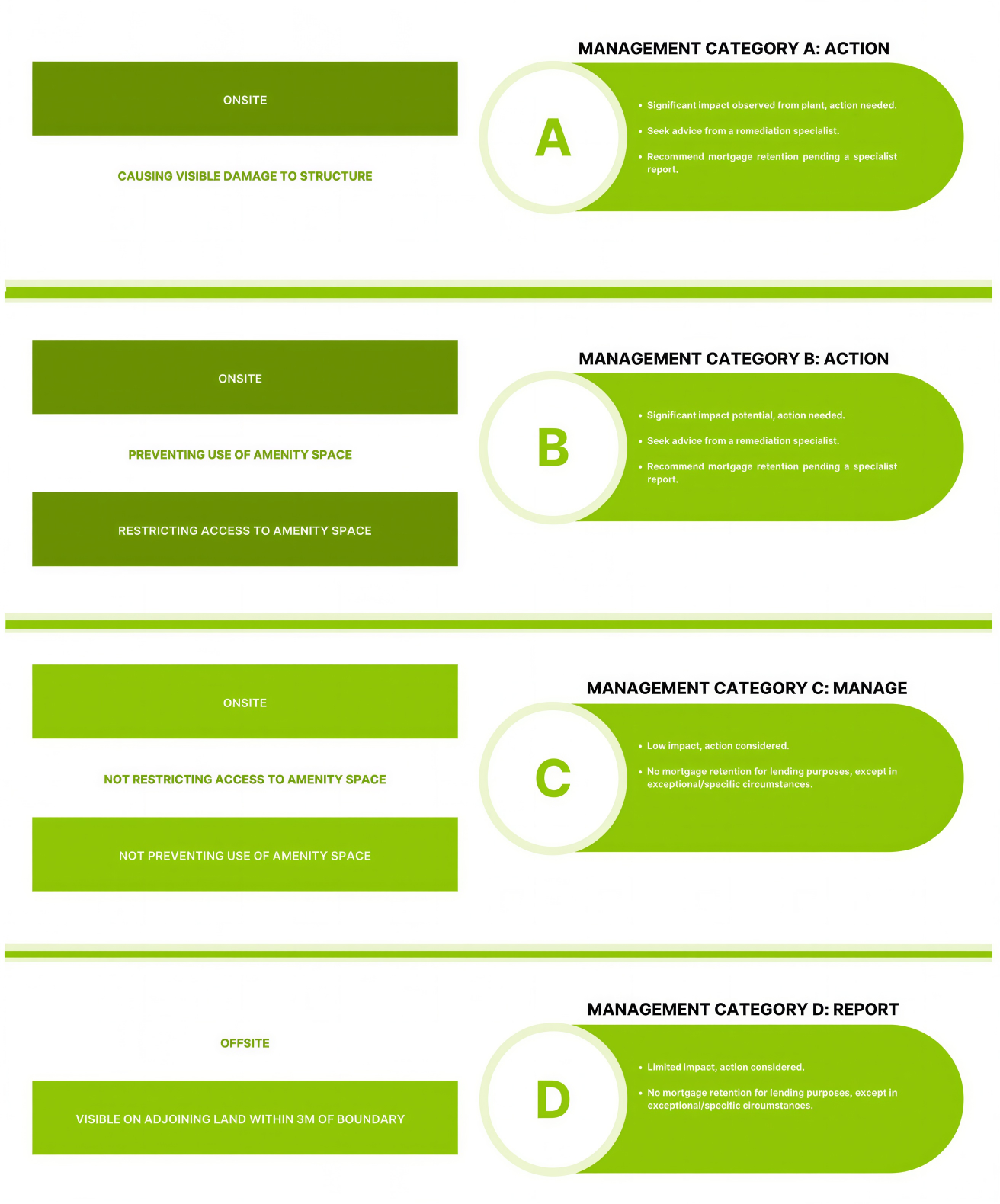
If amenity areas are affected, this can affect property value even though the knotweed may be some distance from the houses. Smaller plots are more likely to be affected, as any reduction in amenity area is likely to be material. Lenders will want assurance that measures are in hand to minimise the impact on the amenity of the property, its value, and its marketability. These considerations look to the general impact of Japanese knotweed rather than the effect it may have in the immediate vicinity.
If it is in well-established planting areas on larger plots or estates, it may well have no effect on the amenity of the property at all. Homeowners may wish to seek advice on long-term management, but lenders may have no reason to insist on remedial works.
Southwest Knotweed complies with the latest Guidance Notes and undertakes assessments that are in accordance with these criteria. The following chart is taken from current RICS guidelines as published and in use since March 2022.