When buying or selling land, it is customary for lenders to require a full survey to be performed before proceeding with an application for the loan.
Our reports are prerequisites for mortgage applications and can also be used to apply for building permission and planning permission.
The Domestic Japanese Knotweed Management Plan has been developed to offer an amenable solution, yet it is fully compliant with the stipulations set forth by the lenders.
The first step is to engage a survey from a Property Care Association member and certificated Japanese Knotweed (CSJK) Surveyor. They will verify the Japanese Knotweed area and its severity, along with the implications of the stand. They will subsequently provide an in-depth survey report with a proposed programme of remedial works. This programme will need to have an Insurance Backed Guarantee for 10 years, which most mortgage providers request before they can move forward.
Japanese Knotweed has become somewhat of an exaggerated threat in recent years due to its coverage in the media. Its reputation is far worse than the actual threat it poses to a property. It is genetically vigorous, but it will not grow through sound concrete. It can weaken concrete, stone, etc., which may eventually lead to it causing damage.
If it is on the property or even on an adjoining property, it must be reported to your mortgage lender before exchange of contracts. Mortgage lenders are not uniform in their approach. Some will only lend if there is a management plan in place, some will only lend if it is a certain distance from the property, and some will not lend at all.
Our advice to clients is to determine as early as possible whether it is present on the property and, if so, to draw up a management plan. A 10-year, insurance-backed treatment plan can usually be drawn up for from £3,500+ VAT. It sounds like a lot of money, but it will save you a lot of time and expense in the long run.
Even where you have remediated Japanese Knotweed prior to sale, you must disclose to the purchaser that the property is affected by a historic Japanese Knotweed infestation.
If you are selling a property affected by Japanese Knotweed, you will be required to complete a series of pre-contract enquiries on a document known as the TA6 form. Questions will include: –
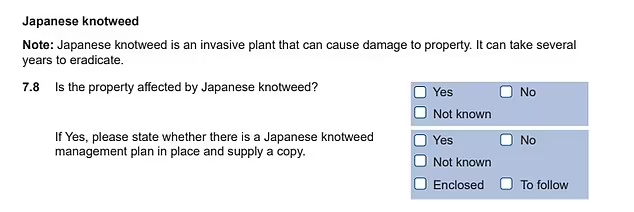
The first thing to do is get a professional survey from companies who are members of the Property Care Association (PCA), such as Southwest Knotweed, who have certificated surveyors in Japanese Knotweed (CSJK).
The survey will confirm the existence and extent of any Japanese knotweed, as well as any risk it poses. Importantly, the survey will also include a report and a suggested programme of works for its remediation, with a 10-year Insurance Backed Guarantee (IBG). Most lenders will require this to be done before they even begin processing your buyer’s application.
Japanese knotweed is a non-native, invasive plant that can exploit weaknesses in the built environment. Effective management requires several years of treatment to prevent the plant from regrowing.
Our management plans also include a Site Visit Record after every visit detailing the work carried out to manage the Japanese Knotweed, so that there is complete transparency. They also provide peace of mind for mortgage companies that are concerned about the Japanese Knotweed’s effect on property valuation.
The management plan for Japanese Knotweed must be provided by the seller to the buyer.
Southwest Knotweed has attended properties where the seller has not disclosed the Japanese Knotweed. In this case, the buyer has had no recourse but to pursue a claim against the seller. This can amount to thousands of pounds in legal fees and be devastating for the seller if it is proven that they failed to disclose this information deliberately.